If you already have a reverse mortgage and you're staring down a big expense a roof repair, medical bills, helping a grandchild with tuition it's natural to wonder if you can tap even more of your home's equity with a HELOC. The short answer is: generally, no. Most lenders won't let you open a home equity line of credit on top of a reverse mortgage. But that's not the whole story. There are real reasons behind this rule, a few exceptions worth knowing about, and some smart alternatives that might get you exactly what you need. Let's walk through all of it.
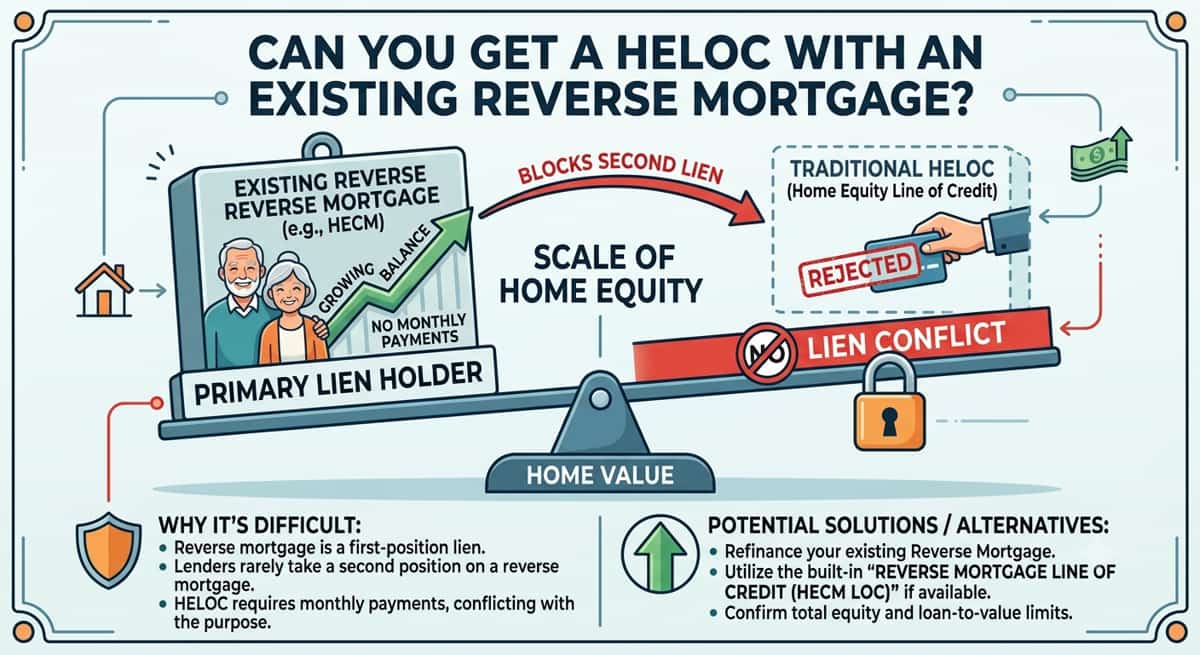
A reverse mortgage has to sit in "first position" on your home's title. That's just a technical way of saying it needs to be the primary loan attached to your house, ahead of any other loan.
A HELOC, on the other hand, is almost always a second loan. It sits behind whatever mortgage is already there. So if you already have a reverse mortgage taking up that first-position spot, there's no room left for a HELOC in the way lenders typically structure these loans.
It's worth being precise here, because this isn't some hard legal wall it's a lending and insurance rule. FHA-insured reverse mortgages (called HECMs) require that first-lien position to keep the loan insured. Most banks and credit unions simply won't approve a HELOC behind one, because it adds too much risk on their end. So while it's not impossible in every conceivable scenario, it's extremely rare and hard to find in practice.
How Reverse Mortgages and HELOCs Work
Before we go further, it helps to be clear on what each of these loans actually is, since people often mix up the details.
What Is a Reverse Mortgage (HECM)?
A reverse mortgage lets homeowners age 62 and older borrow against their home's equity without making monthly mortgage payments. Instead, the loan balance grows over time and gets repaid when you sell the home, move out permanently, or pass away. The most common type is the Home Equity Conversion Mortgage (HECM), which is insured by the FHA. Because of that insurance, the lender requires the reverse mortgage to be the only loan or at least the first loan against your home.
What Is a HELOC?
A home equity line of credit works more like a credit card that's backed by your house. You get approved for a credit limit based on your equity, and you can draw money as needed, paying interest only on what you use. Unlike a reverse mortgage, a HELOC does require monthly payments, and it almost always sits in second position, behind your primary mortgage.
Put simply: a reverse mortgage wants to be first in line. A HELOC is built to be second in line. That mismatch is the whole reason this gets complicated.
Why Lenders Restrict Second Liens on Reverse-Mortgaged Homes
This isn't just an arbitrary rule lenders made up to be difficult. There are real practical reasons behind it.
For FHA-insured HECMs specifically, the first-lien requirement is baked into the program itself. The government insures these loans so lenders are protected if the home's value doesn't cover the full loan balance down the road. That protection only works cleanly if the reverse mortgage has priority over every other debt on the house.
If a second loan, like a HELOC, were allowed behind it, things could get messy fast. If you were ever unable to keep up with taxes, insurance, or home upkeep requirements that come with any reverse mortgage and the loan needed to be resolved, having a second lender in the mix creates competing claims on the property. That's a headache for everyone, and it's exactly what lenders and insurers try to avoid.
This is a bit different for proprietary reverse mortgages, sometimes called jumbo reverse mortgages, which are offered by private lenders rather than backed by the FHA. These loans aren't bound by the same federal insurance rules, so in rare cases, a lender might have more flexibility. But even then, most companies still stick to the same first-lien-only approach, because it protects their investment too.
If you want to read the official guidelines yourself, HUD and the Consumer Financial Protection Bureau (CFPB) both publish plain-language explanations of how HECMs work and what lien requirements apply.
Are There Any Exceptions or Workarounds?
While a standard HELOC usually isn't in the cards, there are a few paths worth understanding.
Proprietary Reverse Mortgages and Lender-Specific Policies
Proprietary reverse mortgages aren't government-insured, policies can vary by lender. It's uncommon, but worth a direct conversation with your loan servicer or an advisor if you have this type of loan, since the rules aren't as standardized as they are with a HECM.
Paying Off the Reverse Mortgage First
One real option is refinancing out of your reverse mortgage entirely paying it off in full, often using other funds or by selling other assets and then applying for a traditional HELOC afterward as your only lien. . This isn't the right move for everyone, since it means giving up the reverse mortgage's no-monthly-payment structure, but for some homeowners with other resources, it opens the door back up to more flexible borrowing.
Home Equity Sharing or Investment Agreements
Some companies now offer home equity investment agreements, where you receive a lump sum in exchange for a share of your home's future value, rather than a traditional loan. These are a different kind of product entirely, not a HELOC replacement, and they come with their own trade-offs. But for homeowners who've been told no everywhere else, it's worth knowing this category exists and asking an advisor whether it fits your situation.
What Happens If You Try to Add a HELOC Anyway?
If you go ahead and apply for a HELOC without addressing your existing reverse mortgage, the most likely outcome is simply a denial. Lenders will see the reverse mortgage during underwriting and decline the application, since it doesn't meet their lien requirements.
What you want to avoid is trying to place any kind of lien on the home without your reverse mortgage servicer's knowledge or consent. Reverse mortgage agreements typically include language that treats an unapproved second lien as a violation of the loan terms. That can trigger serious consequences, including the servicer calling the loan due. In the worst case, that could put your home at risk of foreclosure if the balance can't be repaid.
This isn't meant to scare you it's simply how these agreements are structured, and it's exactly why talking to your servicer or an advisor before taking any action is so important.
Alternatives to a HELOC When You Already Have a Reverse Mortgage
The good news is that needing extra funds doesn't mean you're out of options. Here are the paths most homeowners in your position actually end up exploring.
Reverse Mortgage Line of Credit (If Available on Your Existing Loan)
This is the one people overlook most often. Many HECMs are set up with a built-in line of credit feature, and if you didn't draw the full amount when you first took out the loan, that unused portion may still be sitting there, available to you. It's often the simplest and fastest solution, and it doesn't require a new application or a second loan at all.
Refinancing Into a Larger Reverse Mortgage
If your home's current value has gone up, or if current reverse mortgage limits have increased since you first took out your loan, you may be able to refinance into a new, larger reverse mortgage. . This can free up additional funds without adding a second lien.
Selling and Downsizing
For some homeowners, selling the current home and moving into something smaller or less expensive frees up a significant amount of equity in cash, without any of the lien complications above. It's a bigger life decision, but it's a legitimate option worth considering, especially if the home no longer fits your needs.
Personal Loans or Other Unsecured Credit
Depending on the amount you need, a personal loan or other unsecured credit option might cover the gap without touching your home's title at all. These typically come with higher interest rates than home-secured borrowing, so they tend to make more sense for smaller, shorter-term needs rather than large expenses.
How to Know Which Option Fits Your Situation
Every homeowner's situation looks a little different, and the right path really depends on a few key factors: how much equity you have left, your age, whether your reverse mortgage is a HECM or a proprietary loan, and what you actually need the money for. Someone looking to cover a one-time home repair is in a very different spot than someone hoping to supplement monthly income long-term.
In my experience working with homeowners in this exact situation, the built-in reverse mortgage line of credit is the answer more often than people expect. It's just not something most people realize they still have access to. But it's not the right fit for everyone, which is why it's worth sitting down and mapping out your specific numbers before deciding anything.
Talk to a Licensed Mortgage Advisor Before Making a Move
If you're weighing your options after a reverse mortgage, the smartest first step is a conversation, not an application. A licensed mortgage advisor can look at your specific loan, your home's current value, and your goals, and help you figure out whether an existing line of credit, a refinance, or another path makes the most sense for you. Every homeowner's numbers are different, and getting personalized guidance before you act can save you time, money, and unnecessary stress.