
Your monthly payment was manageable at first. Then rates climbed, the draw period ended, and suddenly your budget felt like it was working against you. If that sounds familiar, you're not alone and you're not out of options.
If you have a Home Equity Line of Credit, you already know how useful it was when you needed a flexible way to tap into your home's value for renovations, big expenses, or life's unexpected moments. But a HELOC comes with a variable interest rate, and that rate doesn't stay still forever. When it rises, your payment rises with it. And when your draw period ends, the full principal kicks in, sometimes doubling or tripling what you were paying before.
That's where refinancing your HELOC into a fixed-rate loan becomes worth a serious look. Converting your HELOC into a fixed-rate product gives you one predictable monthly payment, no surprise rate hikes, and a clear finish line for when your debt is finally paid off. It's not the right move for everyone but for many homeowners, it's the step that brings their finances back under solid ground.
What Is a HELOC and Why Do Homeowners Refinance It?
A Home Equity Line of Credit commonly called a HELOC lets you borrow against the equity you've built in your home, similar to how a credit card works. You get access to a set credit limit, you borrow what you need, pay it back, and borrow again. It's flexible, and for a while, it can feel like a great deal. But over time, many homeowners discover that the flexibility comes with a catch and that's exactly why refinancing becomes a conversation worth having.
How a HELOC Works: Draw Period vs. Repayment Period
A HELOC has two distinct phases. The first is the draw period, which typically lasts 5 to 10 years. During this time, you can borrow from your credit line as needed, and most lenders only require you to pay the interest each month. Payments are low, and the arrangement feels manageable.
Then comes the repayment period, usually 10 to 20 years. The credit line closes, and you can no longer borrow. Now you're required to repay both the principal and interest on whatever balance remains. Because a HELOC is a form of revolving credit tied to your home equity, the shift from draw to repayment can be significant especially if you've accumulated a large balance over the years.
Why Variable Rates Create Risk for Homeowners
Here's where things get unpredictable. A HELOC carries a variable interest rate, meaning your rate isn't locked in; it moves up and down based on the prime rate, which is tied to decisions made by the Federal Reserve. When the economy shifts and the Fed raises rates, your HELOC rate follows. Your monthly payment goes up, not because you borrowed more, but simply because the market changed. For homeowners on a fixed budget, this kind of uncertainty can be genuinely stressful. You can't plan around a number that keeps moving.
The "Payment Shock" Problem When the Draw Period Ends
Many homeowners are caught off guard when their draw period ends. During the draw phase, paying only interest keeps monthly costs low, sometimes just a few hundred dollars. But once the repayment period begins, that same balance now requires full principal-and-interest payments spread over the remaining loan term. It's not uncommon for a monthly payment to jump by $400, $600, or even more overnight. This sudden increase is what mortgage professionals call payment shock, and it's one of the most common reasons homeowners start exploring their refinance options.
What Does It Mean to Refinance a HELOC into a Fixed-Rate Loan?
Refinancing your HELOC means replacing it with a new loan product that offers a fixed interest rate one that stays the same for the life of the loan. Instead of a payment that fluctuates with the market, you get a single, predictable number every month. There are two main ways to do this, and the right path depends on your current mortgage situation, how much equity you have, and what your financial goals are.
Converting a HELOC to a Fixed-Rate Home Equity Loan
The first option is to replace your HELOC with a fixed-rate home equity loan. Like your HELOC, this is a second mortgage meaning it sits behind your existing first mortgage in terms of repayment priority, which is called lien position. The key difference is how it works: instead of a revolving credit line, you receive a lump sum upfront and repay it in equal monthly installments over a set loan term, typically 10 to 30 years.
Think of it like trading in a credit card for a personal installment loan. The balance is fixed, the rate is fixed, and the payment is fixed. You always know exactly what you owe and when you'll be done. Closing costs apply, but they're generally lower than a full mortgage refinance.
Refinancing a HELOC into a New First Mortgage (Cash-Out Refinance)
The second option is a home equity refinancing , where you replace your existing first mortgage and your HELOC with a single, brand-new first mortgage. The new loan pays off both your original mortgage and your HELOC balance, rolling everything into one monthly payment with one fixed rate.
This approach can simplify your finances significantly and may result in a lower blended interest rate especially if your current first mortgage rate is higher than today's market. However, it does restart your amortization schedule, meaning you begin a new 15- or 30-year payoff clock. Closing costs are also higher since you're refinancing the full loan amount. It's worth the math, but it requires a careful look at the numbers with a mortgage advisor before moving forward.
Fixed-Rate Home Equity Loan vs. HELOC: A Quick Comparison
Feature | HELOC | Fixed-Rate Home Equity Loan |
Interest Rate | Variable (moves with prime rate) | Fixed for life of loan |
Monthly Payment | Fluctuates | Consistent and predictable |
How Funds Are Received | Draw as needed (revolving) | Lump sum upfront |
Repayment Structure | Interest-only, then principal + interest | Principal + interest from day one |
Rate Risk | High | None |
Best For | Ongoing or uncertain expenses | One-time payoff or consolidation |
5 Signs It's the Right Time to Refinance Your HELOC
Not every homeowner needs to refinance their HELOC but for many, there are clear signals that it's time to make a move. If any of the following situations sound familiar, it's worth having a conversation with a mortgage advisor sooner rather than later.
Your Draw Period Is Ending Soon
If your draw period is within 12 to 24 months of closing, now is the time to prepare not after the repayment period begins. Refinancing before the transition gives you time to shop for the best rate, qualify without pressure, and avoid the payment shock that catches so many homeowners off guard when the full principal kicks in.
Interest Rates Have Risen Significantly
If rates have climbed since you opened your HELOC, you're likely paying more each month than you expected. Because your HELOC rate moves with the prime rate, every Federal Reserve rate increase hits your payment directly. Locking into a fixed rate now protects you from future increases and gives you stability regardless of what the market does next.
You Want Predictable Monthly Payments
If you're budgeting for a mortgage, car payment, college tuition, or retirement, a payment that changes every month works against you. A fixed-rate loan eliminates that uncertainty entirely. You'll know your exact payment on day one and it won't change for the life of the loan, making financial planning significantly easier.
You Have Significant Home Equity Built Up
Lenders typically require you to retain at least 15% to 20% equity in your home after refinancing. If your home has appreciated in value or you've paid down a meaningful amount of your mortgage you may have more than enough equity to qualify for favorable terms. More equity generally means better rates and more options.
You're Planning to Stay in the Home Long-Term
Refinancing comes with closing costs, so it makes the most financial sense when you plan to stay in your home long enough to recoup those costs through your monthly savings. If you're settled in your home and not planning to sell in the near future, the long-term savings of a fixed rate can far outweigh the upfront expense.
HELOC Refinance Options: Which Path Is Right for You?
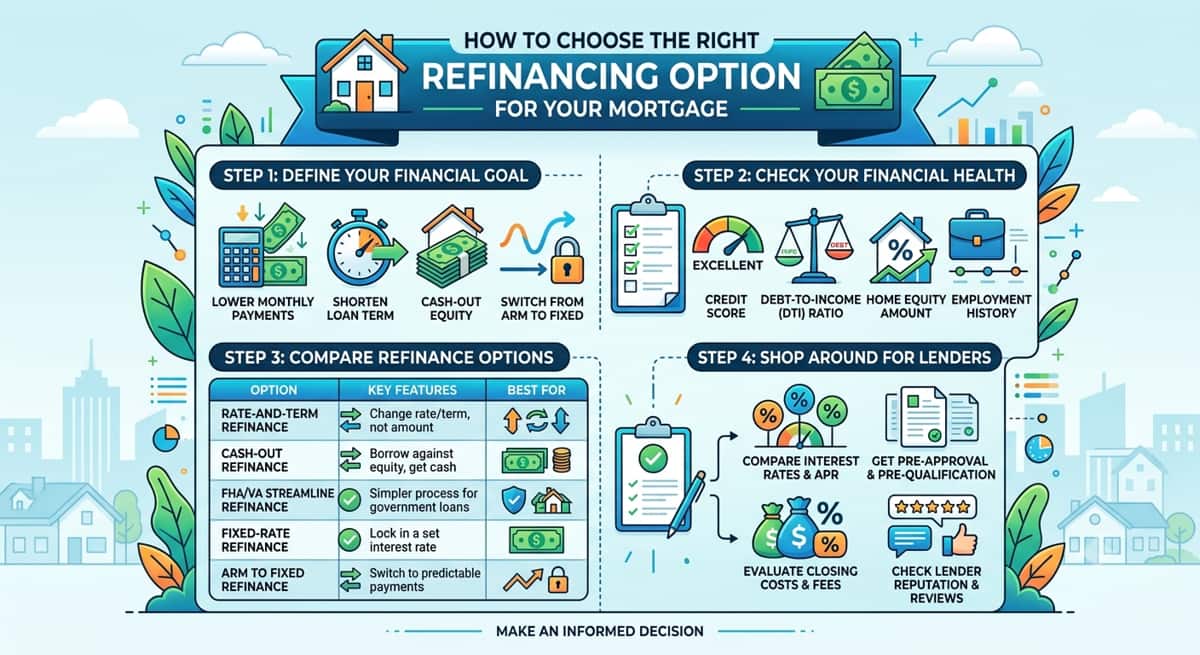
There's no single right answer when it comes to refinancing a HELOC. It depends on your current mortgage, your equity, your credit profile, and what you're trying to accomplish financially. Here's a clear look at your three main options so you can start thinking about which direction fits your situation.
Option 1 — Convert Your HELOC to a Fixed-Rate Home Equity Loan
This is the most straightforward path. You replace your variable-rate HELOC with a fixed-rate home equity loan, keeping it as a second mortgage behind your existing first mortgage. Your HELOC balance becomes a fixed loan with a set term, a locked interest rate, and equal monthly payments from start to finish.
This works well when: You want to keep your existing first mortgage intact especially if you locked in a low rate in recent years and you simply want to stabilize your HELOC payment.
Pros:
Rate is fixed for the life of the loan no more surprises
Monthly payment is predictable and easy to budget
You don't have to touch your existing first mortgage
Cons:
Sits in second lien position, which typically means a slightly higher interest rate than a first mortgage
You'll have two separate mortgage payments each month
Closing costs still apply, though generally lower than a full refinance
Option 2 — Cash-Out Refinance to Pay Off the HELOC
With a cash-out refinance, you take out a brand-new first mortgage that is large enough to pay off both your existing mortgage and your HELOC balance. Everything gets rolled into one loan with one fixed rate and one monthly payment.
This works well when: Your current first mortgage rate is relatively high, or you want the simplicity of a single payment and your home has enough equity to support the larger loan amount.
Pros:
One loan, one payment much simpler to manage
Potentially lower blended interest rate if your current mortgage rate is above market
Fixed rate eliminates all variable-rate exposure
Cons:
Restarts your mortgage amortization clock you begin a new 15- or 30-year term
Higher closing costs since you're refinancing the full loan balance
Requires sufficient equity; most lenders follow Fannie Mae and Freddie Mac guidelines requiring you to maintain at least 20% equity after the refinance
Option 3 — Consolidate Your HELOC into a New First Mortgage
This option is similar to a cash-out refinance but is specifically worth considering when your remaining first mortgage balance and HELOC balance together represent a significant portion of your home's value. Rather than carrying two loans, you consolidate everything into a single new first mortgage.
This approach makes the most sense when current market rates are equal to or lower than your existing first mortgage rate, when you have a strong credit profile and solid equity position, and when you have enough remaining loan term that restarting the clock doesn't cost you significantly more in total interest. A mortgage advisor can run the numbers side by side to show you whether consolidation saves or costs you money over time.
HELOC Refinance Options at a Glance
Option | Best For | Key Consideration |
Convert to Fixed-Rate Home Equity Loan | Homeowners with a low existing first mortgage rate | Keeps two separate payments; second lien position |
Cash-Out Refinance | Homeowners who want one simple payment | Restarts mortgage term; higher closing costs |
Consolidate into New First Mortgage | Homeowners with higher existing mortgage rates | Requires strong equity and favorable market rates |
How to Qualify for a HELOC Refinance: Lender Requirements Explained
Before a lender approves your refinance, they'll look at several key factors to decide whether you qualify and what terms they're willing to offer. Understanding what lenders are looking for before you apply helps you go into the process with realistic expectations and gives you time to strengthen your position if needed. Here's what typically matters most.
Minimum Credit Score Requirements
Your credit score is one of the first things a lender checks. For most HELOC refinance products, lenders look for a minimum score somewhere between 620 and 680, though the best rates are generally reserved for borrowers with scores of 740 or higher. A stronger score signals to lenders that you've managed debt responsibly, which makes you a lower-risk borrower. If your score has taken a hit recently, it may be worth spending a few months paying down balances and correcting any errors on your credit report before applying. Your mortgage advisor can pull your credit and give you an honest read on where you stand.
Loan-to-Value (LTV) Ratio and Home Equity Thresholds
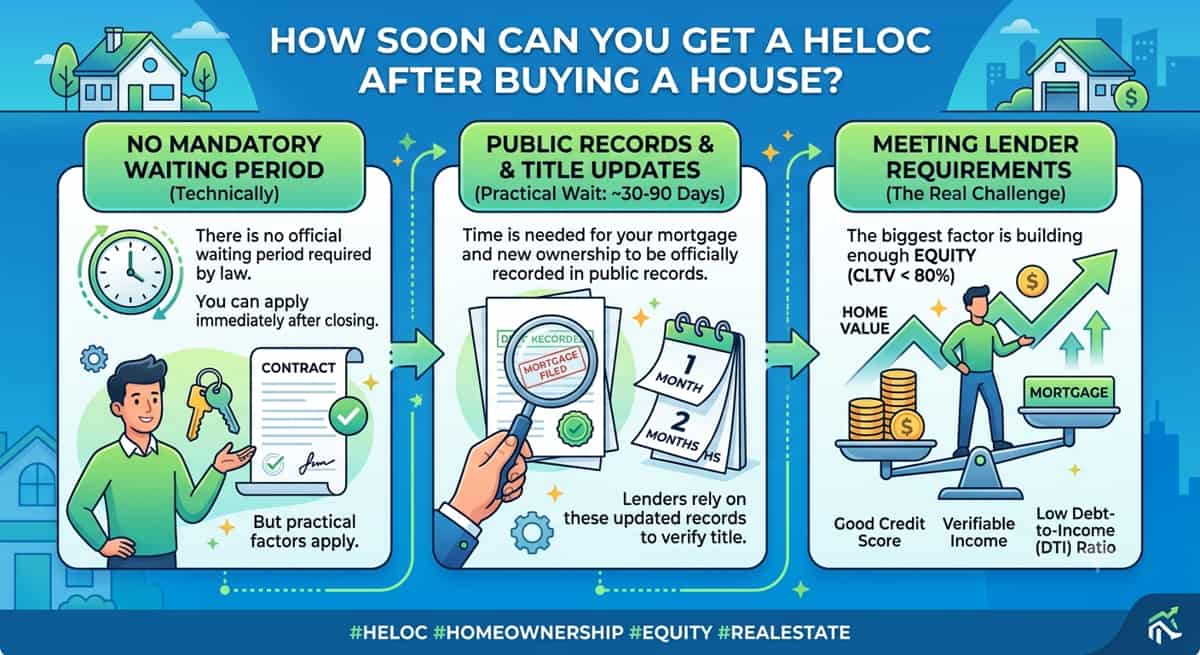
Lenders use your loan-to-value ratio or LTV to measure how much you owe compared to what your home is worth. If your home is worth $400,000 and you owe $300,000 across all loans, your LTV is 75%. When a refinance involves more than one loan, lenders look at the combined loan-to-value (CLTV), which adds your first mortgage and HELOC balances together. Most lenders require your CLTV to stay at or below 80% to 85% after refinancing, meaning you need to retain a meaningful equity stake in your home. The more equity you have, the more options and better rates become available to you.
Debt-to-Income (DTI) Ratio Guidelines
Your debt-to-income ratio(DTI) compares your total monthly debt payments to your gross monthly income. Lenders use this to determine whether you can comfortably afford the new payment. Most conventional lenders prefer a DTI of 43% or lower, though some programs allow up to 50% depending on other strengths in your application, such as strong credit or significant equity. To calculate yours, add up all monthly debt obligations mortgage, car loan, student loans, minimum credit card payments and divide by your gross monthly income. If your DTI is on the higher end, reducing other debts before applying can meaningfully improve your chances.
Home Appraisal and Property Value Considerations
In most cases, refinancing your HELOC will require a home appraisal and a professional assessment of what your home is currently worth on the open market. This matters because your equity, your LTV, and ultimately your loan approval are all based on that number. If your home has appreciated since you bought it, that's generally good news it may mean more equity and better terms. If values in your area have declined, it could affect how much you're able to borrow or whether you qualify at all. The appraisal is ordered through the lender and typically costs between $300 and $600. Your lender's underwriting team uses this value along with your credit, income, and equity position to make a final decision on your loan.
Costs of Refinancing a HELOC into a Fixed-Rate Loan
Refinancing isn't free and being upfront about the costs involved is important before you decide whether it's the right move. The good news is that for many homeowners, the long-term savings from a fixed rate more than cover the upfront expense. But you need to know the numbers going in so you can make a clear-eyed decision.
Closing Costs: What to Expect
When you refinance a HELOC, you'll typically pay closing costs ranging from 2% to 5% of the loan amount. On a $100,000 loan, that's roughly $2,000 to $5,000 out of pocket or rolled into the loan balance if your lender allows it. These costs usually include an origination fee (what the lender charges to process your loan), an appraisal fee to confirm your home's current value, title insurance to protect against any ownership disputes, and various recording and administrative fees. Some lenders offer "no-closing-cost" refinance options, but be aware those costs don't disappear. They're typically built into a slightly higher interest rate over the life of the loan.
Prepayment Penalties on Your Existing HELOC
Before you refinance, check your current HELOC agreement for a prepayment penalty clause. Some lenders charge a fee, often a flat amount or a percentage of the outstanding balance if you pay off your HELOC within a certain period, sometimes within the first two to three years of opening the line. Not all HELOCs have this provision, but it's worth reviewing your original loan documents or calling your lender directly to confirm. A prepayment penalty can add hundreds or even thousands of dollars to your refinance costs, and it's the kind of detail that catches people off guard if they don't check ahead of time.
How to Calculate Your Break-Even Point
Before committing to a refinance, it's worth knowing how long it will take to recoup your closing costs through your monthly savings. The formula is straightforward:
Break-Even Formula
Total Closing Costs ÷ Monthly Payment Savings = Break-Even Months
Example: $4,000 in closing costs ÷ $200 in monthly savings = 20 months to break even
If you plan to stay in the home beyond that point, refinancing likely makes financial sense.
If your break-even point is 18 months and you plan to stay in the home for the next 10 years, refinancing is almost certainly worth it. If you're thinking about selling in two years, the math may not work in your favor. A mortgage advisor can run this calculation with your actual numbers so you're not guessing.
Fixed-Rate Home Equity Loan vs. HELOC: A Side-by-Side Comparison
If you're trying to decide whether refinancing makes sense, it helps to see both options laid out clearly next to each other. A HELOC and a fixed-rate home equity loan are both second mortgages that borrow against your home's equity but the way they work day-to-day is quite different. The right choice depends on what you need the money for, how comfortable you are with payment uncertainty, and where you are in your financial life right now.
A HELOC works like a revolving credit line, flexible, but unpredictable. A fixed-rate home equity loan works more like a traditional installment loan structured, stable, and straightforward. Here's how they compare across the factors that matter most to most homeowners:
Feature | HELOC | Fixed-Rate Home Equity Loan |
Interest Rate | Variable — moves with the market | Fixed — stays the same for life of loan |
Monthly Payment | Changes month to month | Consistent fixed monthly payment |
Payment Structure | Interest-only during draw period, then full principal and interest | Principal and interest from day one |
How You Access Funds | Draw as needed from revolving credit line | Lump sum disbursement at closing |
Flexibility | High — borrow, repay, borrow again | Low — one-time loan, no redraw |
Interest Rate Risk | High — payment rises when rates rise | None — rate is locked in at closing |
Best For | Ongoing or unpredictable expenses over time | A single large, known expense or debt payoff |
Predictability | Low | High |
If you originally opened a HELOC for flexibility and that flexibility has served its purpose, a fixed-rate home equity loan gives you the stability to finish paying it off without the stress of a moving payment. For homeowners who want to know exactly what they owe every single month, no surprises the fixed-rate loan is almost always the cleaner option.
Step-by-Step Process: How to Refinance Your HELOC into a Fixed-Rate Loan
The refinance process doesn't have to feel overwhelming. When you break it down into clear steps, it becomes much more manageable and knowing what's coming at each stage helps you move through it with confidence. Here's exactly what the process looks like from start to finish.
Step 1 — Review Your Current HELOC Terms
Start by pulling out your original HELOC agreement and reviewing the key details: your current interest rate, remaining draw period or repayment timeline, outstanding balance, and whether any prepayment penalty applies. Knowing exactly what you're working with gives you a clear starting point and prevents any surprises later in the process.
Step 2 — Check Your Home's Current Market Value
Your home's value determines how much equity you have available and equity is the foundation of any refinance. Look at recent sale prices for comparable homes in your neighborhood, or use a reputable online estimator as a starting point. Keep in mind that a formal appraisal ordered by your lender will be the number that officially counts.
Step 3 — Pull and Review Your Credit Reports
Before any lender checks your credit, check it yourself. You're entitled to a free credit report from each of the three major bureaus. Look for errors, outdated negative items, or accounts you don't recognize. Disputing inaccuracies before you apply can meaningfully improve your credit score and help you qualify for better terms.
Step 4 — Compare Lenders and Loan Products
Don't go with the first offer you receive. Reach out to at least three lenders including banks, credit unions, and mortgage companies and compare their rates, loan terms, closing costs, and overall responsiveness. Even a small difference in interest rate can add up to thousands of dollars over the life of your loan, so this step is genuinely worth your time.
Step 5 — Work with a Licensed Mortgage Advisor
A licensed mortgage advisor who holds an active NMLS license can do the comparison work for you, access loan products across multiple lenders, and help you identify the option that fits your specific financial situation. If you're unsure where to start, the Consumer Financial Protection Bureau (CFPB) offers a free "Find a Housing Counselor" connect you with a HUD-approved professional in your area.
Step 6 — Submit Your Application and Lock Your Rate
Once you've chosen a lender and loan product, you'll submit a formal application along with supporting documents, typically pay stubs, tax returns, bank statements, and information about your existing mortgage and HELOC. Once approved, your lender will offer you the option to lock your rate, which protects you from market fluctuations while your loan moves through underwriting and closing.
Step 7 — Close on Your New Fixed-Rate Loan
At closing, you'll review and sign your final loan documents. Your new fixed-rate loan pays off the HELOC, and from that point forward, you have one predictable payment at a rate that won't change. Closing typically takes 30 to 45 days from application, though timelines can vary by lender. Once you've signed, you're done and your payment is locked in for good.
Tax Implications of Refinancing a HELOC
Taxes are one area where a lot of homeowners have questions and where it's easy to make assumptions that don't hold up come filing season. The rules around home equity loan interest and deductibility have changed in recent years, so it's worth understanding the basics before you refinance.
Is the Interest on a Fixed-Rate Home Equity Loan Tax Deductible?
It depends on how you use the money. According to IRS Publication 936, interest on a home equity loan may be tax-deductible if the funds are used to buy, build, or substantially improve the home that secures the loan. In that case, it may qualify as a qualified residence loan, making the interest eligible for the mortgage interest deduction but only if you itemize deductions on your tax return rather than taking the standard deduction.
If you're refinancing a HELOC that was used for home improvements, there's a reasonable chance the interest remains deductible. If the original funds were used for other purposes such as paying off credit cards or covering personal expenses the interest likely is not deductible under current IRS rules.
When to Consult a Tax Professional
Tax law is nuanced, and the deductibility of your specific loan depends on factors unique to your situation: how the original HELOC funds were used, how your new loan is structured, and whether itemizing makes sense for you at all given today's higher standard deduction thresholds. Before you refinance and certainly before you file, sit down with a licensed CPA or tax advisor who can review your full picture and tell you exactly where you stand. A one-hour conversation could save you from a costly mistake.
Common Mistakes to Avoid When Refinancing a HELOC
Even homeowners who do their homework sometimes stumble on details that end up costing them real money. These are the mistakes that come up most often and the ones that are entirely avoidable when you know what to watch for.
Not Shopping Multiple Lenders
Accepting the first offer you receive is one of the most common and most expensive mistakes homeowners make. Rates, fees, and loan terms vary more than most people expect from one lender to the next. Getting quotes from at least three lenders takes a few extra days but can save you thousands over the life of your loan. Loyalty to your current bank doesn't always pay off here.
Ignoring Total Loan Costs (APR vs. Rate)
A low interest rate can look appealing until you factor in the fees. The Annual Percentage Rate (APR) gives you the true cost of the loan because it includes both the interest rate and lender fees rolled into one number. Always compare APRs not just rates when evaluating offers side by side. A loan with a slightly higher rate but lower fees can easily be the better deal overall.
Refinancing Too Late in the Draw Period
Waiting until your draw period has already ended or is weeks away from ending puts you in a rushed, reactive position. Lenders need time to process applications, order appraisals, and complete underwriting. Starting the refinance conversation at least 6 to 12 months before your draw period closes gives you breathing room to shop carefully and choose the right loan without pressure.
Overlooking Prepayment Penalty Clauses
Some HELOCs include a clause that charges you a fee for paying off the balance early, sometimes within the first two to three years of the loan. If you refinance without checking for this first, you could face an unexpected charge that significantly reduces your savings. Always review your original HELOC agreement or call your lender directly before moving forward.
Failing to Account for Home Value Changes
Your refinance options are directly tied to your home's current market value, not what it was worth when you first opened the HELOC. If home values in your area have declined, you may have less equity than you assumed, which can affect your loan-to-value ratio and the terms you qualify for. Getting a realistic read on your home's value early in the process helps you set accurate expectations before you apply.
Conclusion — Is Refinancing Your HELOC into a Fixed-Rate Loan Right for You?
Refinancing a HELOC isn't a decision you need to rush but it is one worth thinking through carefully, especially if your draw period is winding down, your rate has climbed higher than you'd like, or you're simply tired of a payment that doesn't stay still.
The right move depends on where you are right now: how much equity you've built, what your credit looks like, how long you plan to stay in the home, and what you're trying to accomplish financially. For many homeowners, converting to a fixed-rate loan is the decision that finally brings clarity and control back to their monthly budget. For others, the timing or numbers may not yet line up and that's equally important to know before you commit.